
Are Citations Still Worth Building in 2026? The Reddit Argument Both Sides Got Wrong
Search Reddit for local citations, and you will usually find two extreme answers. One side says citations are still essential. The other says they are dead. Both sides miss the practical point. In 2026, citations still matter, but only in the right situations and only as part of a broader local SEO budget.
TL;DR
- Citations are still useful in 2026, but they are not a major growth lever on their own.
- They matter most for new businesses, inconsistent NAP data, new locations, and niche directories.
- Mature brands should treat citation building as maintenance, not a large ongoing investment.
The two camps: citations matter vs. citations do not
The citation debate usually gets framed too simply.
One side says citations still matter because Google needs consistent business information across the web. From this view, every business should keep building directory listings to support local rankings.
The other side says citations are no longer worth the effort. They argue that Google now relies more on reviews, links, website quality, proximity, engagement, and Google Business Profile signals.
Both are partly right.
Citations are not dead. But they are also not the ranking shortcut they once were. For most businesses, they are a trust and consistency signal. They help search engines verify that a business is real, active, and accurately represented across the web.
That does not mean hundreds of low-quality directory listings will move rankings.
The better question is not, “Are citations worth it in 2026?”
The better question is, “What problem are we trying to solve?”
What 2024–2026 ranking factor research actually shows
Recent local SEO research points to a more balanced answer.
The Whitespark Local Search Ranking Factors report continues to show that local rankings are influenced by many signals, including Google Business Profile optimization, reviews, on-page SEO, links, proximity, and behavioral signals. Citations still appear in the local SEO mix, but they are not treated as the main driver of competitive rankings.
BrightLocal’s Local Consumer Review Survey 2025 also shows how important reputation and review behavior remain in local decision-making. That matters because citations can help a business be found, but reviews often help a customer decide.
RankZ’s local citation guidance also frames citations around accuracy, consistency, and trust rather than volume alone. Its local citation strategy guide highlights the importance of consistent name, address, and phone number information across platforms.
So the practical takeaway is clear.
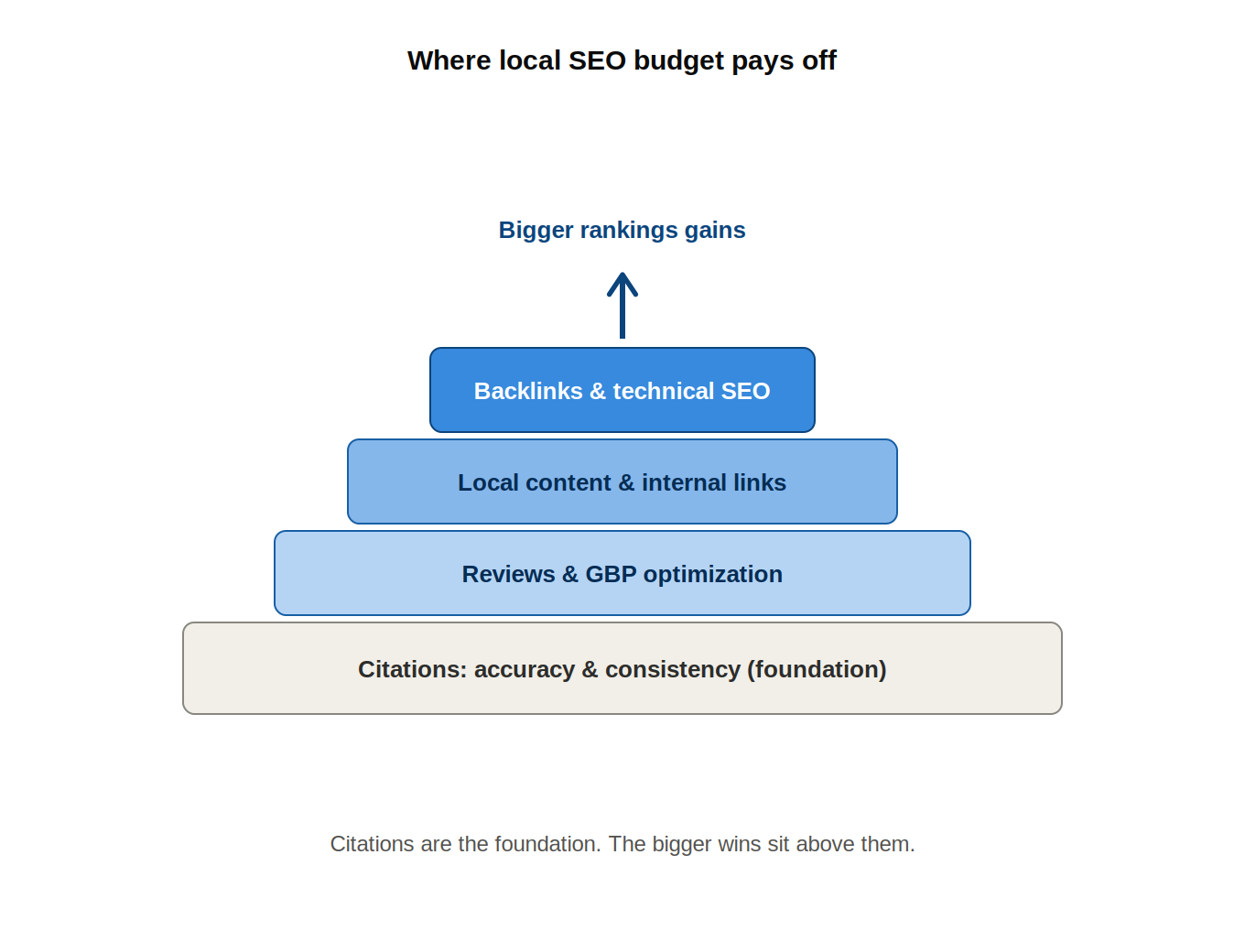
Citations are still part of local SEO. But they work best as infrastructure, not as the main campaign.
What counts as a citation?
A citation is any online mention of a business’s key details.
This usually includes:
- business name
- address
- phone number
- website
- hours
- category
- location details
Citations can appear on directories, map platforms, review sites, local chambers, industry associations, data aggregators, and niche listing sites.
Some citations include links. Some do not.
That is important because the value is not always about backlinks. Sometimes the value is business verification. Sometimes it is referral traffic. Sometimes it is customer trust.
When citations still move the needle
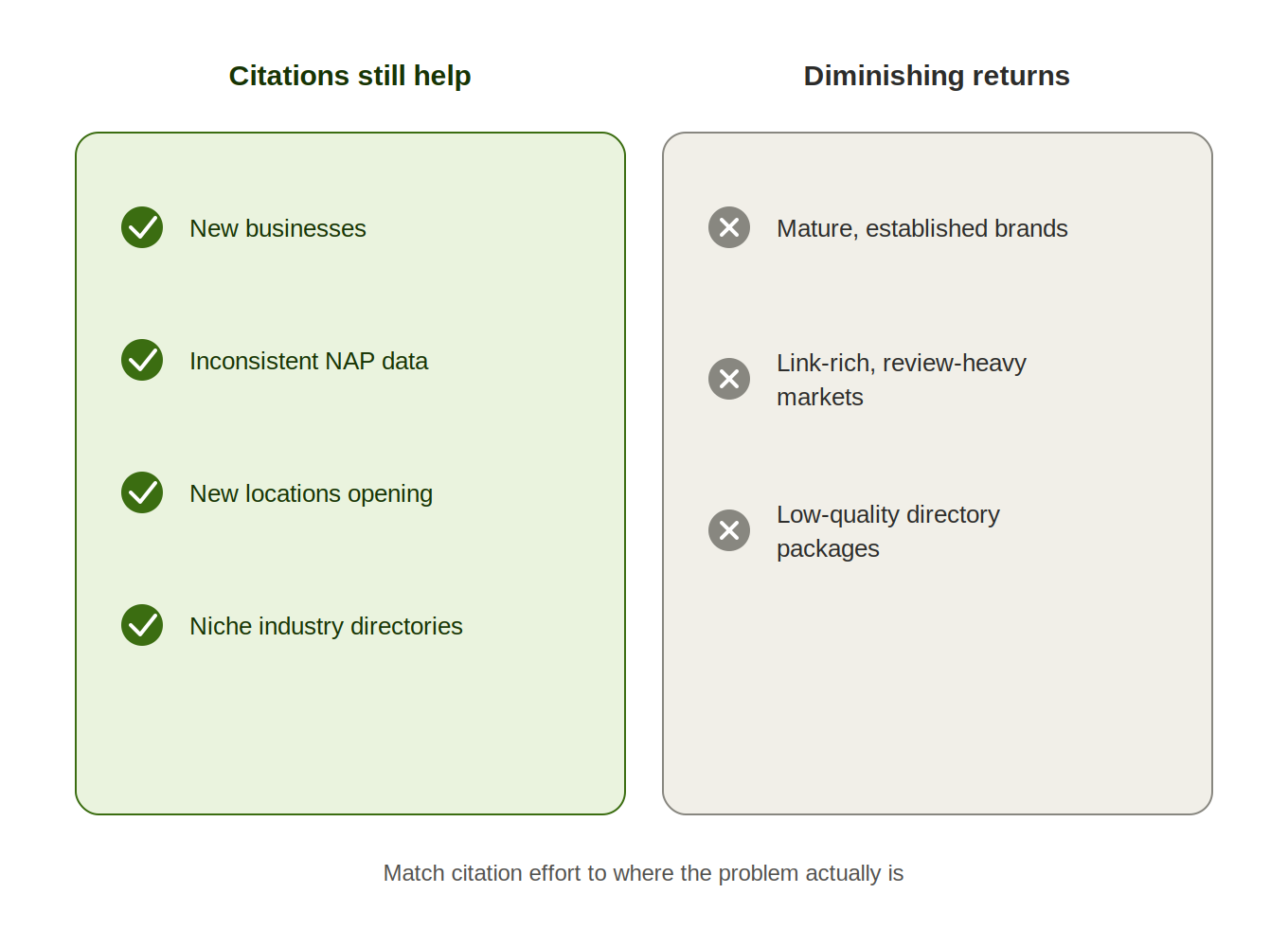
Citations can still be worth building when they solve a clear problem.
New businesses
New businesses often have a thin online footprint.
Google may not yet have enough supporting signals to confidently understand the business, location, and service area. Accurate listings on trusted platforms can help establish a baseline presence.
This does not mean a new business needs hundreds of listings. It means the business should appear correctly on the platforms that matter.
For a new location, the priority should be:
- Google Business Profile
- Apple Business Connect
- Bing Places
- major map platforms
- relevant review platforms
- trusted industry directories
This helps create a clean local footprint from the start.
Businesses with inconsistent NAP data
Citation cleanup can be more valuable than citation building.
NAP stands for name, address, and phone number. If a business has changed its name, moved locations, updated phone numbers, changed its website, or adjusted hours, old listings can create confusion.
Customers may call the wrong number. They may visit the wrong address. Search engines may also see conflicting information across the web.
For these businesses, the best citation work is not adding more listings. It is fixing the important ones.
Multi-location brands opening new locations
For multi-location brands, citations still matter at the location level.
Each branch needs accurate local data across major platforms. This is especially important when a brand opens in a new market, relocates, or uses different phone numbers by location.
A strong national brand does not automatically solve local data accuracy for each branch.
If one location has clean data and another has outdated listings, the customer experience can still break at the local level.
Niche and industry directories
Not all citations are equal.
A listing on a relevant industry directory can be more valuable than a listing on a generic directory that no customer uses.
For example, a professional association, licensing body, local chamber, or industry-specific directory may support both trust and referral traffic.
These listings can matter even if the SEO benefit is limited.
The best citation question is:
“Would a real customer trust or use this source?”
If the answer is yes, the listing may be worth building.
When citations do not move the needle
Citation building becomes less valuable when the business already has a strong local authority.
Mature brands
Established businesses often already have wide citation coverage.
If the business information is accurate and the major listings are already claimed, adding more low-quality directories is unlikely to produce meaningful gains.
At that point, citation work should shift into monitoring and maintenance.
That means checking for accuracy, fixing errors, and updating listings when business details change.
Link-rich or review-heavy verticals
In competitive markets, citations rarely decide who wins.
Businesses with strong backlinks, strong reviews, optimized location pages, and active Google Business Profiles usually have more powerful advantages.
If competitors are winning because of authority, reputation, and content, more directory submissions will not close the gap.
Low-quality directory packages
Many citation packages promise scale. That does not always mean value.
Submitting a business to dozens or hundreds of weak directories can create clutter without improving visibility. It may also make future cleanup harder if the business changes details later.
In 2026, citation quality matters more than citation count.
A smaller number of accurate, trusted, relevant listings is usually better than a large batch of generic listings.
Budget-allocation framework
Citation building should have a place in the budget, but not an oversized one.
For most businesses, we would treat citations as a foundation layer. They should be fixed early, maintained over time, and reviewed when major business details change.
They should not consume the same budget as reviews, content, technical SEO, or authority building unless the citation profile is clearly messy.
1. Fix the foundation first
Start with the core business data.
Make sure every location has accurate:
- name
- address
- phone number
- website URL
- business hours
- categories
- service area details
This should match the website, Google Business Profile, and major listing platforms.
If the data is inconsistent, fix that before investing in new content or link campaigns. Conflicting local data creates friction for both customers and search engines.
2. Claim the major platforms
Every location should be accurate on the main platforms that customers actually use.
This usually includes Google Business Profile, Apple Business Connect, Bing Places, major maps, and major review or directory platforms relevant to the business.
This is not optional SEO work. It is basic local visibility work.
3. Prioritize niche citations
After the major platforms are correct, look for high-value niche listings.
Prioritize directories that meet at least one of these standards:
- Customers actually use them
- They are specific to the industry
- They are tied to licensing or professional trust
- They are locally relevant
- They can send referral traffic
This is where citation building can still produce value.
4. Stop before returns drop
Once the core and niche citations are complete, do not keep spending just to increase citation count.
Move budget into higher-impact local SEO work, such as:
- review generation
- review response systems
- location page improvements
- local content
- internal linking
- technical SEO
- backlink acquisition
- Google Business Profile optimization
For most mature businesses, these areas will produce better returns than more citations.
Decision tree: Should you invest in citation building in 2026?
Use this quick framework to decide whether citation building deserves a meaningful share of your local SEO budget.
Start
│
Is this a new business or location?
│
┌──────────────┐
Yes No
│ │
Build accurate listings Has the business
on major platforms first information changed?
(Google, Apple, Bing, etc.) │
│ ┌───────────────────┐
│ Yes No
│ │ │
│ Audit and correct Already listed on
│ existing citations major platforms?
│ │
│ ┌──────────────────────────┐
│ No Yes
│ │ │
│ Complete core listings Focus budget on:
│ and relevant niche • Reviews
│ directories • GBP optimization
│ • Local content
│ • Backlinks
│ • Technical SEO
└───────────────────────────────────────►
Review citation accuracy annually
Bottom line: If your business has accurate listings on the major platforms and relevant industry directories, additional citation building usually delivers diminishing returns.
At that point, your budget will often produce better results when invested in reviews, Google Business Profile optimization, local content, backlinks, and technical SEO.
So, are citations worth it in 2026?
Yes, but only with the right expectations.
Citations are worth it when they improve accuracy, build trust, support new locations, or place the business in directories customers actually use.
They are not worth it when the goal is to create hundreds of generic listings and expect rankings to jump.
That is where both sides of the Reddit argument get it wrong.
Citations are not dead. They are also not enough.
They are a local SEO foundation. Once that foundation is clean, the bigger gains usually come from stronger content, better reviews, stronger pages, better links, and more complete Google Business Profiles.
FAQs
Are citations still worth it in 2026?
Yes. Citations are still worth it when they help confirm accurate business information and support local trust. They are less useful as a standalone ranking tactic.
Are local citations dead?
No. Local citations are not dead, but their role has changed. They are now more about data accuracy and trust than ranking power by volume.
Do citations help Google Business Profile rankings?
They can help support consistency, especially for new businesses or locations with messy data. But they are only one part of local SEO and should not replace review, content, and GBP work.
How many citations does a business need?
There is no fixed number. A business should focus on major platforms, trusted local directories, and relevant industry listings. After that, more listings usually bring smaller returns.
Should multi-location brands build citations for every location?
Yes. Each location should have accurate listings. Multi-location brands should treat this as location data management, not a one-time bulk submission project.
Are paid citation services worth it?
They can be worth it if they clean up important listings, fix inconsistent data, and maintain accuracy. They are less useful when they only submit to large numbers of low-quality directories.
Sources
- Whitespark, Local Search Ranking Factors
- BrightLocal, Local Consumer Review Survey 2025
- BrightLocal Research Hub
- RankZ, Local Citation Strategies

Paul Warren is the co-founder and Head of SEO at the Local Agency and has over 15 years of enterprise SEO experience.