
Subfolders vs. Subdomains vs. Separate Domains for Multi-Location Sites — What Actually Wins in 2026
Choosing the right multi-location SEO site structure affects more than URLs. It shapes how authority flows, how local teams work, and how easily the site can grow. For most brands, subfolders are still the safest default. Subdomains and separate domains can work, but only when the business case is strong.
TL;DR
- Subfolders are best for most multi-location SEO site structures because they keep authority and management under one domain.
- Subdomains can work when local teams need real autonomy, but they add technical and operational complexity.
- Separate domains should usually be reserved for legal, M&A, co-branded, or independently operated local brand situations.
Why this question is the #1 multi-location SEO debate on Reddit
The subdomain vs. subfolder local SEO debate keeps coming up because the choice feels simple at first. A brand just needs to decide where its local pages should live.
The three common options are:
example.com/locations/location-name/
location-name.example.com
locationbrand.com
But this is not only a URL decision. It affects link equity, crawl management, brand control, analytics, content workflows, and future migration risk.
The core trade-off is clear. Subfolders consolidate authority. Subdomains and separate domains create more local autonomy.
That is why this question appears often in local SEO communities, franchise discussions, and site migration planning. The RankZ summary of local SEO discussions from Reddit reflects the same practical concern: business owners want to know how to scale local visibility without creating duplicate, thin, or hard-to-manage pages.
The Local Search Forum multi-location category also shows how broad this issue can become. Multi-location SEO is not just about URL structure. It also involves location pages, Google Business Profiles, reviews, local content, citations, and brand consistency.
Our recommendation is simple: start with subfolders unless the business has a clear reason not to.
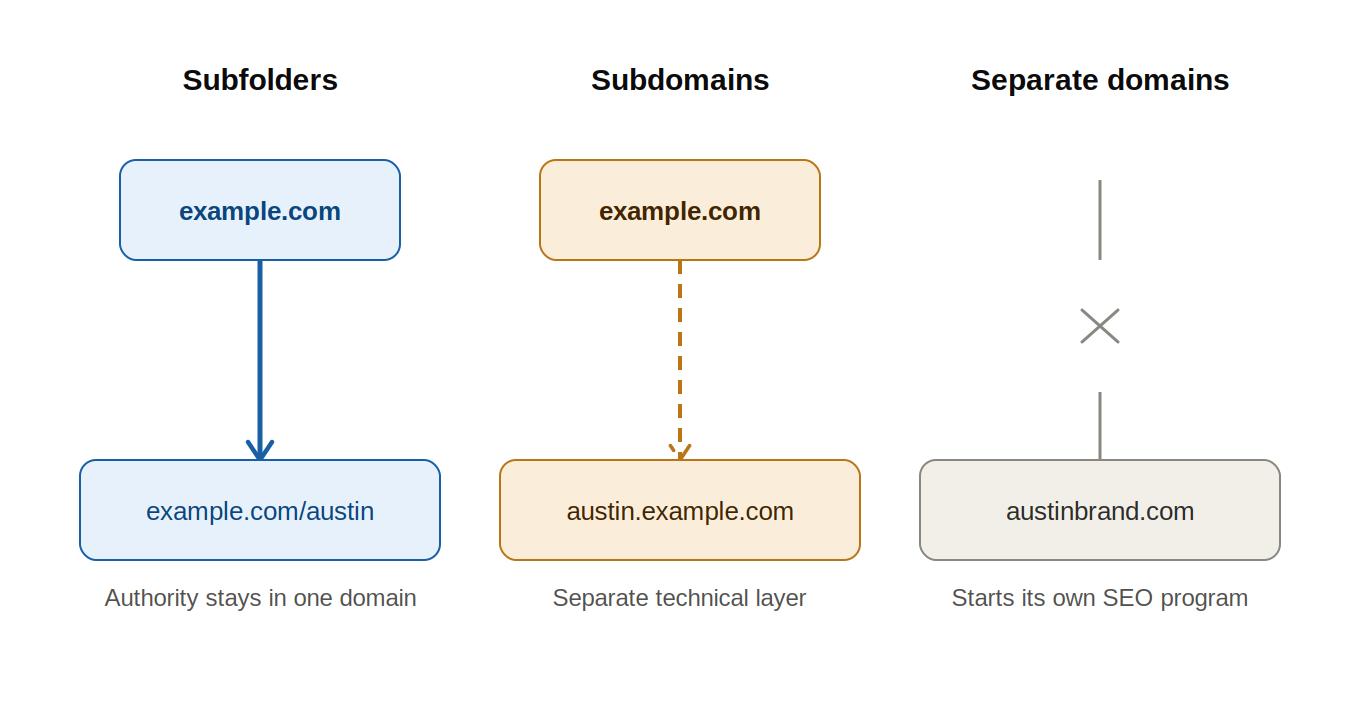
Option A: subfolders
Subfolders are the default choice for most multi-location websites.
A subfolder keeps each local page inside the main domain. The homepage, blog, service pages, location pages, and supporting resources all live together. This makes the site easier to manage and easier to scale.
Google’s URL structure best practices recommend simple, logical, human-readable URLs. A structure like this is clear for users and easy for internal teams to understand:
example.com/locations/
example.com/locations/state/
example.com/locations/state/city/
example.com/locations/state/city/location-name/
The main SEO benefit is consolidation. If a location page earns a strong backlink, it is still part of the main domain. If the homepage and service pages build authority, the location pages can benefit from being part of the same site structure.
That does not mean every location page will rank just because it sits in a subfolder. Each page still needs useful local content. But subfolders reduce wasted effort because you don’t have to start from scratch in every location.
Subfolders also make internal linking cleaner. A central site can connect regional pages to city pages, city pages to location pages, and service pages to the right local markets. This helps users move through the site and gives search engines a clearer view of how the business is organised.
This model scales well when the company has one main brand, shared services, one CMS, one analytics setup, and one central SEO or marketing team. It is often the best fit for healthcare groups, home service brands, gyms, restaurants, storage brands, and retail chains.
The trade-off is content quality. Subfolders can make it easy to create hundreds of pages, but that does not mean the pages are good. A weak location page that only swaps the city name is not a strong SEO asset.
A useful location page should include real local details. That may include address and hours, directions, location-specific services, local photos, provider or team details, nearby service areas, local reviews, appointment details, and location-specific FAQs.
For service-area businesses, the structure may also include service pages by city or market:
example.com/services/service-name/city/
example.com/locations/city/
The right structure depends on how customers search. If people search for a branch or office, location pages should be strong. If people search for a service in a city or market, service-location pages may also be needed.
Option B: subdomains
Subdomains are not automatically bad for SEO. They can rank. They can make sense. But they usually require more planning and maintenance than subfolders.
A subdomain uses a separate hostname, such as:
location-name.example.com
market-name.example.com
region-name.example.com
In practice, that often means more separate systems. There may be separate CMS access, separate templates, separate analytics, separate Search Console properties, and separate technical checks.
Google’s crawl budget documentation explains how crawling resources are managed for larger sites. For a small website, this may not matter much. For a large multi-location network, separate hostnames can add another layer of technical oversight.
Subdomains are most useful when local teams need real autonomy. That might happen in a franchise model where regional teams manage their own content, promotions, booking systems, or compliance requirements.
This is where the subdomain vs. subfolder local SEO debate needs nuance. Google can understand subdomains. The myth is that subdomains cannot rank. That is not true.
The better question is whether the company can manage each subdomain well.
If every subdomain needs its own content standards, internal links, redirects, sitemap, analytics setup, and performance checks, the workload can grow quickly. A large franchise team may be able to handle that. A smaller brand may struggle.
The other issue is migration risk. If the company later decides to move from subdomains to subfolders, the migration can be complex. It often requires URL mapping, 301 redirects, internal link updates, sitemap updates, canonical checks, Google Business Profile URL updates, analytics annotations, and post-launch crawl checks.
A subdomain can be the right choice when autonomy matters more than simplicity. But if the main goal is SEO efficiency, subfolders are usually cleaner.
Option C: separate domains
Separate domains give each location or local brand the most independence. They also create the most SEO work.
A separate domain structure may look like this:
localbrand.com
brand-location.com
locationbrand.com
This model can make sense in legal, M&A, or co-branded scenarios. For example, a national company may acquire a local brand that already has strong name recognition. In that case, keeping the local domain may protect customer trust and existing search demand.
Separate domains can also make sense when locations are independently operated, when legal entities must stay separate, or when a co-branded partnership needs its own digital presence.
But for most unified multi-location brands, separate domains create a link-equity dilution problem.
Each domain has to earn trust on its own. Each one needs content, backlinks, technical maintenance, analytics, citations, reputation management, and local SEO support. Ten domains need ten SEO programs. Fifty domains need fifty SEO programs.
That is why most SEO teams advise against separate domains when the locations share the same brand, services, and marketing team. A separate domain should be a business decision first. SEO can support it, but SEO should not be the only reason to create it.
If the goal is to rank in more cities, separate domains are usually not the answer. Strong location pages under one main domain are usually easier to build, manage, and improve over time.

Real-world examples of each model and how they rank
All three models can rank. The structure alone does not decide success.
A subfolder model can rank well when the main domain has authority, the site has strong internal links, and each location page provides useful local information. This is the most common model we would recommend for a single brand with many locations.
A subdomain model can also rank, especially for large brands that have the technical systems to support it. The key is that the subdomain must not be treated like a forgotten side project. It needs strong content, internal links, tracking, and ongoing maintenance.
Separate domains can rank when each domain has its own brand strength, backlinks, local recognition, and content strategy. This is more common with acquired brands, local operators, dealer networks, or independently owned businesses.
The mistake is copying a large brand’s structure without copying its resources. A national company may succeed with subdomains because it has brand authority, links, technical support, and content systems. A smaller company using the same structure may create more work than value.
So we should not ask, “Which structure ranks?” We should ask, “Which structure can we support well for every location?”
Recommendation + migration path if you picked wrong
For most multi-location businesses in 2026, we recommend this order: subfolders first, subdomains second, and separate domains last.
Subfolders are the strongest default for multi-location SEO site structure because they keep authority, content, tracking, and technical work under one domain. They also make it easier to manage internal links, templates, schema, and location page updates.
Subdomains are a reasonable second choice when local teams need real independence. They are not a shortcut. They require strong governance.
Separate domains should be reserved for cases where the brand, ownership, legal structure, or acquisition history makes separation necessary.
If you already picked the wrong structure, do not rush the fix. Start with a migration audit. List the important URLs, backlinks, organic landing pages, paid landing pages, Google Business Profile links, citation links, and high-performing location pages. Then map every old URL to the best new URL.
A good migration plan should include one-to-one 301 redirects, updated internal links, updated XML sitemaps, updated canonical tags, updated schema URLs, updated Google Business Profile website links, analytics annotations, rank tracking, and post-launch crawl checks.
For larger sites, migrate in phases. Test one region or business unit before moving the full network.
Some ranking movement is normal after a migration. What matters is whether the new structure is cleaner, easier to crawl, easier to manage, and easier to improve.
The goal is not only to recover rankings. The goal is to build a structure that can support the next stage of growth.
FAQ
Are subfolders always better for local SEO?
No. Subfolders are usually better for a unified multi-location brand because they keep authority and management in one place. But subdomains or separate domains can make sense when ownership, technology, or legal requirements are separate.
Does Google penalise subdomains?
No. Subdomains are not a penalty risk by themselves. The challenge is management. A subdomain often needs its own technical checks, tracking, internal links, sitemaps, and content standards.
Should every city get its own page?
Only if the page can be useful. A real office, store, clinic, or service area can support a strong local page. A thin page that only swaps the city or market name is unlikely to perform well.
Should service-area businesses build city pages?
Sometimes. Service-area businesses should be careful not to imply they have offices where they do not. City pages can work when they include real service details, local proof, reviews, projects, and helpful information.
Can franchises use subdomains?
Yes. Subdomains can work for franchises when local teams need more control. But if the parent brand controls the website and marketing, subfolders with role-based permissions are usually simpler.
Are separate domains good for city SEO?
Usually not. Separate domains split authority and create more work. They can be useful for acquired brands, legal entities, co-brands, or independently owned operators, but they are rarely the best choice for one brand with many locations.
What is the best multi-location SEO site structure in 2026?
For most brands, the best structure is a main-domain subfolder system with clear state, city, and location pages. Support it with unique local content, Google Business Profile alignment, structured data, internal links, and a strong review strategy.
Sources
- RankZ, Local SEO for Multiple Locations
- Local Search Forum, Multi-Location Issues
- Search Engine Journal, Local SEO for Multiple Locations
- Search Engine Journal, Subdomains vs. Subfolders
- Search Engine Journal, Localized Folders and Pages for SEO
- Search Engine Journal, Website Architecture for SEO
- Search Engine Journal, Multi-Site SEO Case Study
- Google Search Central, URL Structure Best Practices
- Google Crawling Infrastructure, Crawl Budget Management

Paul Warren is the co-founder and Head of SEO at the Local Agency and has over 15 years of enterprise SEO experience.