
How Often Should You Get New Google Reviews? The Recency Rule Most Businesses Get Wrong
A few new reviews every month usually work better than one large review push twice a year. For local businesses, review recency helps show that customers are still visiting, responding, and sharing current feedback.
TL;DR
- Two reviews a month, every month, is better than forty reviews twice a year.
- Set your target by checking how many new reviews your top three local competitors earn each month.
- A simple front-desk handoff, one 24-hour text, and one 7-day reminder can help many businesses earn 8 to 12 reviews per month.
Why review recency matters more than review count alone
Many business owners ask the same question: how often should I get Google reviews?
The simple answer is this: often enough that your profile looks active.
A high review count helps. A business with 800 reviews will usually look more established than a business with 40. But review count does not tell the whole story.
Customers want to know what the business is like now. Google also says review count and positive ratings can help local ranking, and local SEO testing continues to show that fresh reviews may support visibility and trust signals.
That is where review recency comes in.
Whitespark’s 2025 local SEO article argues that review requests should be part of ongoing local SEO work, not something businesses only do a few times per year. It also points to review recency as a practical signal tied to stronger local performance.
Sterling Sky’s review recency case study showed a similar pattern. In the study, rankings dropped when review activity slowed. Rankings improved again when new reviews started coming in.
That does not mean reviews are the only ranking factor. They are not.
Your Google Business Profile, website, location, content, links, categories, and overall trust all matter. But for local SEO, review recency is one of the clearest signs that a business is still serving customers and earning feedback.
Review count still has value. In a separate Sterling Sky 2025 review-count study, rankings improved when businesses moved from 9 to 10 Google reviews. But the same study also found that adding more reviews after that point did not create the same kind of jump.
The takeaway is clear.
Review count helps you look established. Review recency helps you look current.
Customer cares about that freshness too. In BrightLocal’s Local Consumer Review Survey 2026, 74% of consumers said they focus on reviews written in the last three months. The same survey found that 47% of consumers will not use a business with fewer than 20 reviews.
For local businesses, this means old praise is not enough. A strong review profile needs both history and momentum.
How to set the right monthly review target
There is no universal number that works for every business.
A business in a small suburb may not need the same review pace as a business competing in a dense downtown market. A home services company may face different competition than a restaurant, med spa, law firm, retail store, fitness studio, or local contractor.
We recommend starting with the local market.
Choose one main search term, such as:
- plumber in Charlotte, NC
- best restaurant near me
- med spa Charlotte
- Family Lawyer Charlotte
- HVAC company near me
Then search for that term in the area where your customers are most likely to be located.
Look at the top three Google Maps results. For each one, record:
- Total Google reviews
- Average star rating
- New reviews in the last 30 days
- New reviews in the last 90 days
- Whether the business responds to reviews
The 30-day number shows current review velocity. The 90-day number gives a more stable view. A single busy week can distort the 30-day number, so both views matter.
Here is a simple way to think about it:
| Competitor review pace | Suggested monthly goal |
| Top competitors earn 2 to 4 reviews per month | Aim for 4 to 6 reviews per month |
| Top competitors earn 5 to 8 reviews per month | Aim for 8 to 10 reviews per month |
| Top competitors earn 10 or more reviews per month | Aim for 12 or more reviews per month |
This table is not a ranking formula. It is a planning tool.
For many single-location businesses, 8 to 12 new Google reviews per month is a strong goal. It is enough to create a steady review velocity without putting too much pressure on the team.
The main thing is consistency.
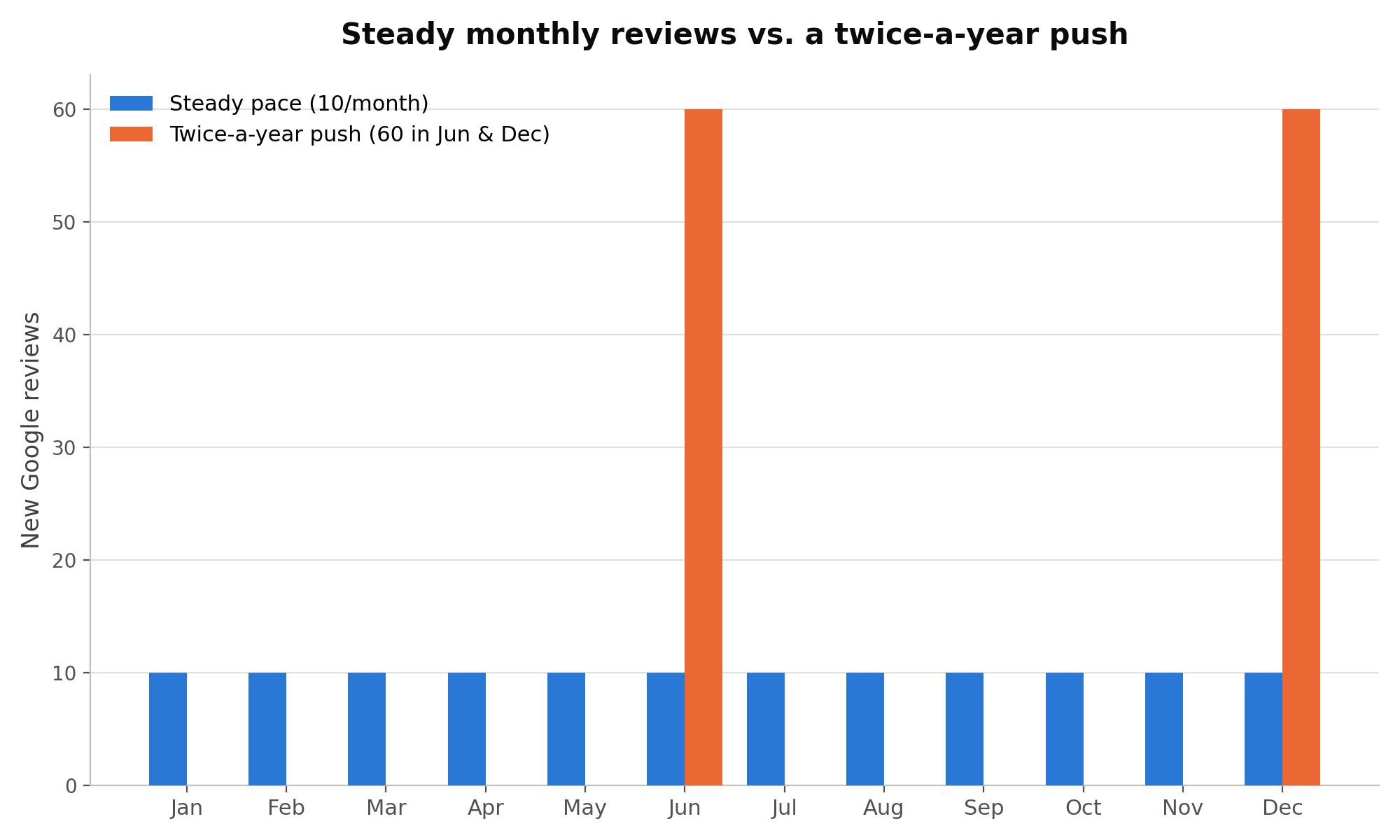
Forty reviews in June and none until December looks like a campaign. Eight reviews every month looks like a healthy business.
A simple workflow to earn 8 to 12 reviews per month
A good local business review strategy should not depend on one person remembering to ask.
It needs a repeatable process.
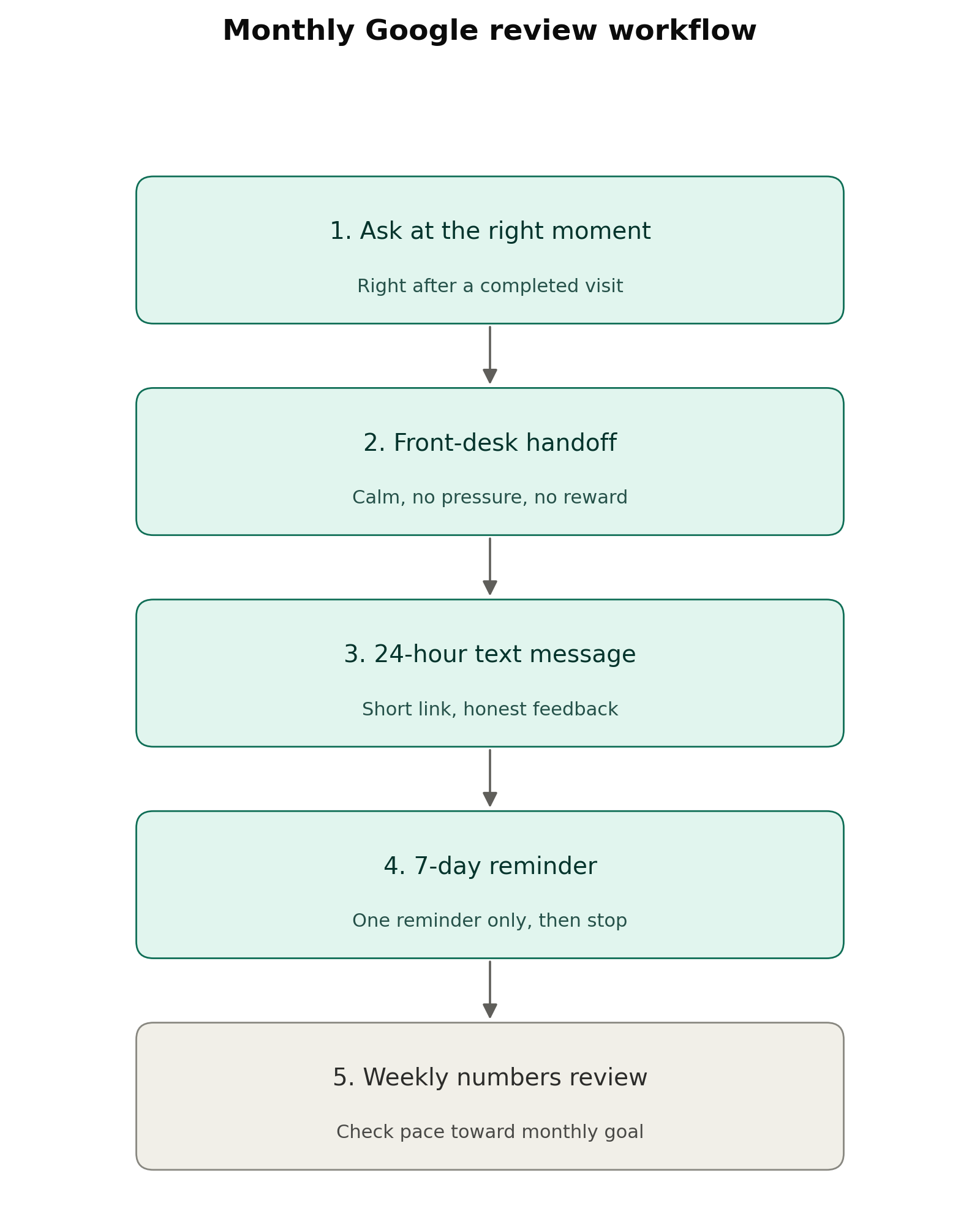
Step 1: Ask at the right moment
The best time to ask is soon after a completed customer interaction. The experience is still fresh, and the customer is more likely to remember the details.
Good moments include:
- A completed service appointment
- A finished project
- A successful delivery or installation
- A positive checkout experience
- A first-time customer visit
- A customer service issue that was resolved well
- A milestone in a longer customer relationship
The request should be routine. It should not be based only on whether the customer seems likely to leave a five-star review.
That matters because selective asking can turn into review-gating.
Step 2: Use a front-desk handoff
The handoff should sound natural. It should also ask for honest feedback, not positive feedback.
Front-desk script
“Thank you for choosing us today. We are always working to improve the customer experience. You may receive a text or email with a link to leave a Google review. We would appreciate your honest feedback.”
This works because it is calm and clear.
It does not pressure the customer. It does not offer a reward. It does not ask for a specific rating.
Step 3: Send a 24-hour text message
BrightLocal’s 2026 survey found that 78% of consumers were asked to write a review in the previous 12 months, and 65% wrote one after being asked. That is a good reminder that people often need a simple prompt.
24-hour SMS template
“Hi [First Name], thank you for choosing [Business Name]. We value your feedback and use it to improve the customer experience. You can share an honest Google review here: [Review Link].”
Keep the message short.
Do not over-explain. Do not ask for a five-star review. Do not offer anything in return. The goal is honest feedback from a real customer.
Step 4: Send one 7-day reminder
One reminder is enough.
7-day reminder template
“Hi [First Name], thank you again for choosing [Business Name]. If you have a moment, we would appreciate your honest feedback on Google: [Review Link].”
Then stop.
Too many reminders can feel pushy. They can also create a poor customer experience.
Step 5: Review the numbers once a week
One person should own the process.
That person should check:
- How many review requests were sent
- How many reviews came in
- Which providers or visit types are being missed
- Which reviews still need a response
- Whether the office is on pace for the monthly goal
This should take about 15 minutes a week.
The goal is not to pressure the team. The goal is to find gaps in the process before the end of the month.

What not to do when asking for reviews
Some review tactics create short-term movement but long-term risk.
Do not review-gate
Review-gating means screening customers before asking for a public review.
For example, a business sends a private survey first. Customers who give a high score receive a Google review link. Customers who give a low score do not.
That creates a biased review profile. It also works against the goal of honest feedback.
Ask consistently after appropriate visits.
Do not offer incentives.
Google’s Maps user-generated content policy says reviews should reflect real experiences and should not be influenced by payment, discounts, free goods, or free services.
That means we should avoid:
- Gift cards for reviews
- Discounts for reviews
- Free whitening for reviews
- Contest entries for reviews
- Requests for a specific star rating
- Staff-written reviews
- Reviews from family members who were not customers
The FTC also finalized a rule in 2024 that targets fake reviews, paid review manipulation, insider reviews, and some forms of review suppression, according to the Federal Trade Commission.
The safest rule is simple.
Ask for honest feedback. Do not reward the review. Do not shape the rating.
Do not rely on bulk email campaigns
A twice-a-year email blast may create a review spike. But it is not a long-term strategy.
It may reach customers who have not visited in years. It may also create uneven review velocity.
A monthly workflow is cleaner. It asks current customers after real visits. It creates a steady pattern. It also gives the team a process they can maintain.
How healthcare Practices can request reviews safely
Businesses should make review requests simple, neutral, and respectful.
A review request should not pressure the customer. It should not reveal private information. It should not mention sensitive details that do not need to be included in a public review.
Use neutral wording.
A safer message says:
“Thank you for choosing our business.”
A risky message says:
“Thank you for purchasing [specific private product] after discussing [personal situation].”
The same rule applies when responding to reviews.
Even if a customer shares details publicly, the business does not need to repeat those details in the response.
A safer review response may say:
“Thank you for your feedback. Our team works hard to provide a helpful and respectful experience. Please contact us directly if you would like to discuss anything further.”
Avoid public replies that include:
- Private account details
- Purchase details the customer did not ask you to repeat
- Employee disputes
- Personal information
- Financial information
- Anything that escalates the conversation
When in doubt, keep it general and move the conversation offline.
How to track review velocity month over month
Review velocity is the number of new reviews a business earns during a set period.
We recommend tracking it every month.
Use a simple spreadsheet like this:
| Metric | Why it matters |
| New Google reviews | Shows monthly review velocity |
| Total Google reviews | Shows long-term review growth |
| Average star rating | Tracks reputation health |
| Review requests sent | Shows whether the team followed the workflow |
| Request-to-review conversion rate | Shows whether timing and wording are working |
| Competitor review gains | Keeps the target grounded in the local market |
| Review responses posted | Shows whether the business is closing the loop |
The conversion rate is especially useful.
If the business sends 120 review requests and earns 12 reviews, the conversion rate is 10%. If it sends 120 requests and earns 2 reviews, the workflow may need attention.
The issue could be timing. It could be the wording. It could be incorrect phone numbers. It could also be that the team is not making the front-desk handoff.
Review responses should also be tracked.
BrightLocal’s 2026 survey found that 89% of consumers expect businesses to respond to reviews, and 81% expect a response within a week. That makes review response part of the trust-building process, not just a courtesy.
That makes review response part of the trust-building process, not just a courtesy.
For related topics, read Article 8 on review text vs. star ratings and Article 9 on how businesses should respond to Google reviews.
Conclusion
So, how often should you get Google reviews?
For most businesses, the answer is every month.
A steady flow of 8 to 12 honest reviews per month is usually stronger than a large review push once or twice a year. It keeps the profile fresh. It helps customers see current feedback. It also gives the team a process they can manage.
Start by checking the top three competitors in your local search results. Set a monthly target. Train the team. Send one timely text or email and one polite reminder. Track the results every month.
That is how review recency becomes a habit, not a campaign.
Sources
- Whitespark: The most underrated local ranking factor in 2025
- Sterling Sky: Does review recency impact ranking
- Sterling Sky: “2025 update: Does the number of Google reviews impact ranking?”
- BrightLocal: “Local Consumer Review Survey 2026”
- Google: “Prohibited and restricted content, Maps user-generated content policy.”
- Federal Trade Commission: “Federal Trade Commission announces final rule banning fake reviews and testimonials.”
U.S. Department of Health and Human Services: “HHS Civil Rights Office enters settlement with dental business over disclosures of customers’ protected health information.”

Paul Warren is the co-founder and Head of SEO at the Local Agency and has over 15 years of enterprise SEO experience.