
City Pages with Only the City Name Swapped: Why Reddit Keeps Warning Against them and What to Do Instead
City pages can support local SEO when they help real users. But pages that only swap the city name often create risk. They can look like thin city pages, duplicate city pages, or doorway city pages.
That is why experienced SEOs keep warning newer teams not to scale them blindly.
TL;DR
- Duplicate city pages SEO becomes risky when every page says the same thing with a different city name.
- Thin city pages can look like doorway pages if they exist mainly to rank for local keywords.
- The safer approach is to create fewer city pages, but make each one specific, useful, and backed by local proof.
The pattern that won’t die and why it’s still being recommended
The pattern is familiar.
A business wants to rank in every nearby city. Someone suggests creating one page for each city. The team builds a template, swaps the city name, and publishes dozens or even hundreds of pages.
A typical version looks like this:
- /service-[city-1]/
- /service-[city-2]/
- /service-[city-3]/
- /service-[city-4]/
At first, this feels efficient.
One page becomes fifty. A service-area business can suddenly target every suburb, town, and neighborhood in its market.
That is why this tactic still gets recommended. It is fast, easy to explain, and looks like progress.
But speed is also the problem.
When every page has the same structure, same service copy, same calls to action, and same claims, the city name is not enough to make the page useful.
Google’s spam policies warn against doorway pages, including pages created mainly to rank for similar searches and send users to the same destination.
That does not mean city pages are always bad.
A city page can be helpful when it gives users information tied to that location, such as:
- Local service details
- Real projects from the area
- Customer reviews from that market
- Neighborhood or service-area coverage
- City-specific questions and answers
The issue is not the city page.
The issue is creating pages where the city name is the only meaningful difference.
How Google detects near-duplicate city pages in 2026
Google does not need two pages to be exact copies to understand that they are very similar.
A page can change the city name, rewrite a few lines, and still look almost identical to the rest of the set.
Search systems can compare more than the words on the page. They can evaluate:
- Page structure
- Headings
- Internal links
- Metadata
- Repeated content blocks
- The overall purpose of the page
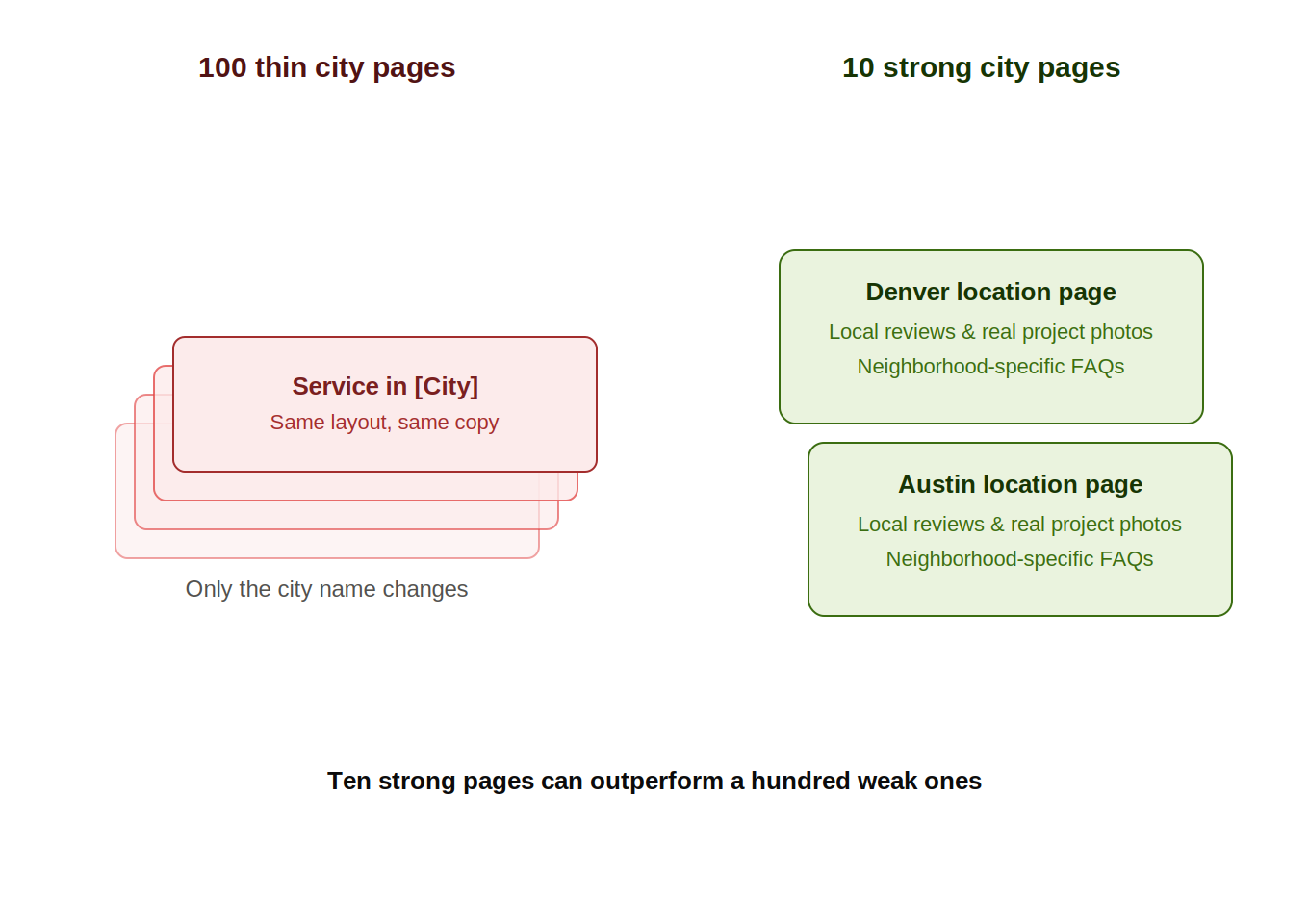
So if a site publishes 100 location pages with the same layout and message, the pattern becomes clear.
This is why many Reddit SEO discussions about city pages are cautionary. The pages may get crawled. Some may rank for a short time. But if they do not offer real local value, they often struggle to stay indexed or earn useful traffic.
AI content has made this problem easier to create.
AI can quickly produce many versions of the same page. But changing sentence order or swapping a few phrases does not automatically create a useful page.
A page can be technically unique and still be thin.
For duplicate city pages SEO, that distinction matters.
Google is not only asking, “Is this copied?”
It is also asking, “Does this page deserve to exist as a separate result?”
What an algorithmic demotion looks like
A site does not always receive a manual penalty when it publishes thin city pages.
More often, the decline is quieter.
Common signs include:
- Some pages never get indexed
- Some pages rank briefly, then fade
- Some pages stay in Google but receive almost no impressions
- The entire location-page section performs worse after a quality update
This can be frustrating because nothing looks obviously broken.
The pages are live. They have title tags. They have internal links. Some may even have several hundred words of copy.
But the content does not add enough value.
A common pattern looks like this: a site publishes a large set of city pages, sees a short burst of crawling, then realises only a small group of pages bring in traffic. The rest sit quietly with little visibility.
That is not always a penalty. Sometimes it is simply Google choosing not to reward pages that look too similar to each other.
The main lesson is simple.
More pages do not always mean more local reach.
In many cases, ten strong city pages can outperform one hundred weak ones.
The “unique-by-default” page model
A better city-page strategy starts with a different question.
Instead of asking, “How many city pages can we publish?”
Ask, “What can we say about this city that we cannot say about every other city?”
That question changes the process.
A strong city page is unique by default. It does not depend on a city-name swap. It includes local proof, local context, and local details that make the page useful on its own.
Here is a simple decision tree to use before creating a new city page:
Should we create this city page?
Before creating a city page, ask:
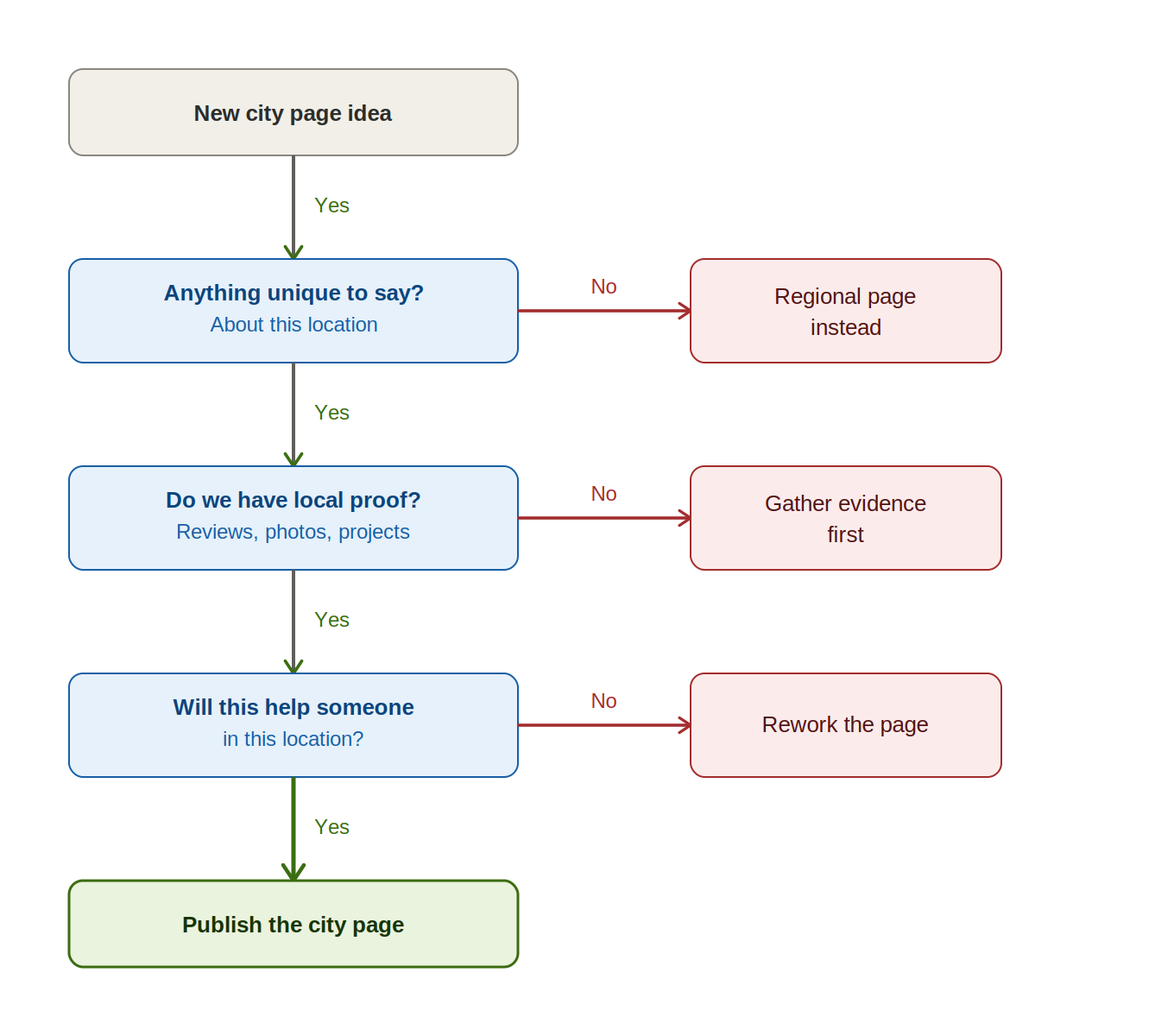
This keeps the standard clear.
If we do not have anything specific to say about the city, we should not create the page yet.
If we have a real reason for the page but no local proof, we should gather that proof before publishing.
Local proof can come from:
- Customer reviews
- Project examples
- Original photos
- Local team details
- Service notes
- City-specific FAQs
A weak city page says:
We provide roofing services in [City]. Contact us today.
A stronger city page explains which neighborhoods the team serves, shows a recent local project, includes reviews from customers in that market, and answers location-specific questions people commonly ask.
The city name is not the value.
The local evidence is the value.
Recovery checklist if you’ve already shipped 100+ thin pages
If your site already has a large set of thin city pages, the first step is not to panic.
The first step is to audit.
Start by checking:
- Which pages are indexed
- Which pages receive impressions
- Which pages earn clicks
- Which pages convert
- Which pages have real local content
Many teams discover that a small number of city pages drive most of the value. The rest exist because they were part of the original scale plan.
Once you see the pattern, group the pages by market.
Nearby towns, suburbs, and low-volume cities may not need separate pages. They may work better as part of a stronger regional page.
Then decide what to improve, merge, or remove.
A simple rule:
- Keep pages with traffic, conversions, or strong local value
- Improve pages with potential but weak proof
- Merge pages that repeat the same intent
- Remove pages with no clear purpose and no realistic path to usefulness
The best recovery work usually includes adding real local evidence. That means customer stories, project details, original photos, service-area notes, and reviews tied to the location.
Internal links also matter.
City pages should not sit alone. They should connect naturally to service pages, location hubs, review pages, Google Business Profile content, and related local guides.
After changes go live, monitor indexation, impressions, clicks, and conversions.
Recovery is rarely instant. But stronger pages give Google and users a better reason to trust the location section.
The goal is not to save every page.
The goal is to make the location strategy worth indexing.
FAQ
Are duplicate city pages bad for SEO?
Duplicate city pages can be bad for SEO when they repeat the same content and only change the city name. The risk is higher when the pages do not provide unique local value.
Are city pages considered doorway pages?
Not always. A city page becomes risky when it exists mainly to rank for local keywords and does not help users in that location. Google’s doorway-page guidance warns against pages created mainly to capture similar searches.
How do I avoid thin city pages?
Avoid publishing a city page until you have local context, local proof, and a clear reason the page should exist. Reviews, project examples, local FAQs, and service-area details can all help.
Should every service-area business create city pages?
No. Some businesses are better served by regional pages, service-area hubs, or stronger core service pages. City pages make sense only when each page can be useful and specific.
Should I delete old thin city pages?
Not immediately. First review performance and quality. Some pages can be improved. Others should be merged into stronger pages. Pages with no traffic, no conversions, and no unique value may be candidates for removal.
Sources
Google Search Central, Spam Policies
RankZ, Local SEO for Multiple Locations
Reddit r/SEO, City Pages Discussions
